Years before Glowforge machines were invented, I used a sandblasting system to create wooden mold templates that produced paper embossments.
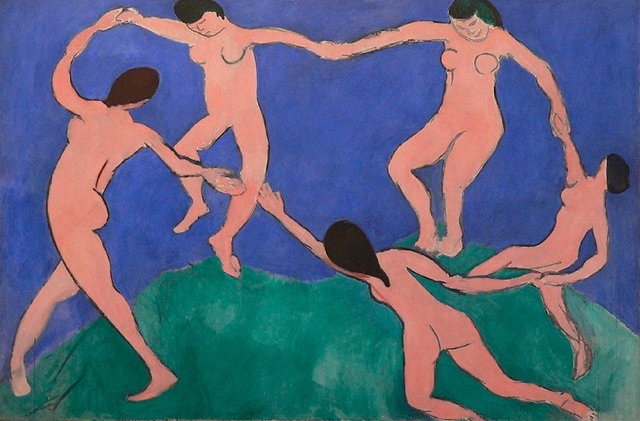
While viewing online some of the paintings that hang on the walls of the Museum of Modern Art (MOMA) in New York, I saw the Henri Matisse painting titled “Dance 1.” It consists of some dancers who encircle and are dancing upon a knoll. (See image below.) I thought I might be able to create a kind of bas-relief of this painting in paper if I could get permission from the appropriate people or organization.
After learning that the Artists Rights Society of New York primarily controls copyright use of many art pieces — including “Dance 1” — in major art museums and galleries, I wrote to them and asked if I could attempt to reproduce this piece in paper. They told me that they would have to contact the Matisse Estate in France to get their permission and that it was highly unlikely that the Matisse Estate would allow this to happen. To everyone’s surprise, the Matisse Estate said that I could send them a couple of paper prototypes and they would consider my request based on my designs.
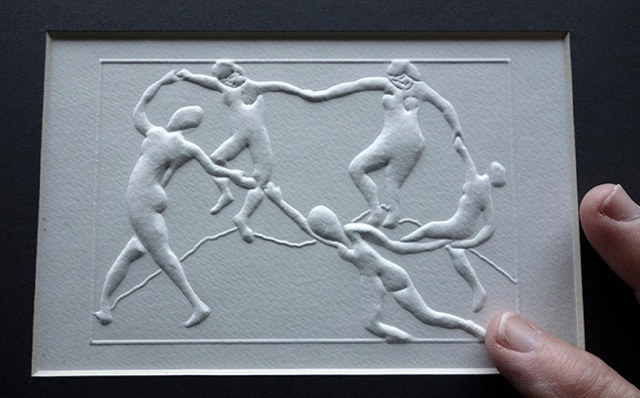
After weeks of waiting, the Matisse Estate approved the paper embossment that you see pictured below. Their only condition was that I could only donate the embossment to galleries and museums, and not receive any money from this embossment. That was fine with me because I had planned on donating the embossment anyway.
The Matisse Estate asked for two of the embossments as did the Museum of Modern Art. MOMA told me that when docents give a tour to visitors who have a disability like low vision or blindness, a visitor can feel where the dancers are located and have a greater appreciation and understanding of this painting.
I’ve donated this embossment to other art galleries and museums as well as to the Perkins School for the Blind in MA. MOMA has an excellent audio description of this painting that can be listened when touching this embossment.
This is the paper embossment now being used by MOMA. It was created using 140 lb. watercolor paper pressed and vacuumed into a wooden mold. It’s about 5" high x 7" wide.
(Note: In an earlier post, forum member “rbtdanforth” suggested that depth engraving was a technique I might consider when using my GF Pro. He was right. I now use an app called SculptOK that helps me create embossments similar to the one shown above. Thanks for this tip!)
This is truly beautiful and I love the whole story. Unfortunately, Bob Danforth has since passed away. He would have loved seeing this and would have appreciated knowing that his tip led to further inspiration. Thanks for sharing your stunning success.
Thank you for this information about Bob Danforth. I wasn’t aware of this. I’m sorry to hear that he has passed away. His suggestion allowed me to make some engravings in acrylic that resulted in paper embossments that I shared with the blind community.
Thanks for this information! Not being a regular contributor, I may need to take classes to learn how to post and reply to things. Maybe you need to be my translator.
Usually children and adults who touch the embossments use a light touch, so I haven’t had to replace any of them. If there is a particularly large, domed area in an embossment, I will use thicker paper that will stand up to repeated touches. I also sometimes use a product by Golden called Fiber Paste that I spread into larger cavities on the back side of the design. Fiber Paste is light weight but very strong and it dries evenly with the back surface of the paper. It remains hidden once the embossment is adhered to a backing sheet like card stock.
Thank you for sharing your work with us! I think it’s wonderful how you contribute to museums and art galleries. Very inspiring. Have you thought about contacting schools for the blind to see if they’d be interested, or would that really put to to work doing more than you want?
That’s a great question. The process that I use to make a single embossment page or panel is very time consuming so my output is smaller than I would like it to be. I have to draw, purchase or use a copyright free design, create black areas that will be cut out, edit and fine-tune it in Photoshop and Silhouette Business Edition software (this outputs the file as an .svg file), size the design(s) to fit within an 8 1/2" x 11" format, use my GF Pro to cut out the design. Then I take a sheet of watercolor or Bristol paper and run it through my printer (to create text) that uses waterproof ink. I then place the paper in a tray of warm water for about 30 seconds. I wipe off excess water and place this sheet on top of the plywood mold, place it in a plastic bag, put this sandwich in my vacuum system and vacuum the bag. This doesn’t always give me the depth and details I need, so I use round-headed clay-working tools to press against the plastic and into the paper.
I have an etching press. If I need deeper impressions, I run the sheet-within-the-plastic bag through the press for even more details. I remove the sheet from the bag, flip it over and dry it on a paper towel. I still need to apply adhesive strips of braille that I create using a slate and stylus, a system used by folks that are blind. Then I place an 8 1/2" x 11’ sheet with adhesive on both sides between the paper embossment and cardstock . Then I punch 3 holes in the left side so that this panel can be placed in a 3-ring binder. Most of my binders contain four to nine pages, so you can understand why I can’t send these binders to many places.
I would love to make or buy a machine that can do all or most of this very quickly, but I haven’t found one yet. I talked with the CEO of a company that makes a machine that does paper embossing, but she said that it would cost her company millions of dollars to retool their setup to do what I needed.
Back to your question. I donate to libraries for the blind, to places like the Lighthouse for the Blind (that often teach people braille) and to specific museums or individuals who use my material in their teaching, like the teacher – mentioned in an earlier post – (herself blind) who provides classes on “Birding by Ear.” She recently asked me if I could create some specific owl embossments for an another class that she teaches. That will be challenging, so any tips on creating paper, touchable owls will be much appreciated!
Sorry to make this reply so long, but I wanted to describe my workflow. Maybe you or others can benefit from this method, especially if you want to make beautiful, individual embossed cards.


 No worries
