You burn the wax out once you’ve made the final mold around it. My experience is about casting the wax in the acrylic mold/pattern to make the positive in the first place. Maybe needed better finishing or release coat or some other trick.
hi JimSocks and all,
this caught my eye as i’ve been making acrylic blanks on the GF and reproducing them in pewter and bronze. apologies if i repeat what others have said that i may have missed. i use delft clay, which is finer than most casting sand, reproduces detail well, and requires less finishing than coarser media. the picture below shows an acrylic model burned on GF, pewter and bronze castings of it, and a different design created by stamping objects directly into a delft clay mold made from a blank model – these are 1.5" diameter. below are some stamps i’ve made in bronze for marking clay molds. i don’t know whether they’d hold up under the stress of your stamping process for leather. the bulbs at the bottom are the buttons, and the rod is the sprue. to make them stronger for stamping, you could make the sprue thicker and perhaps more conical to prevent bending under pressure.
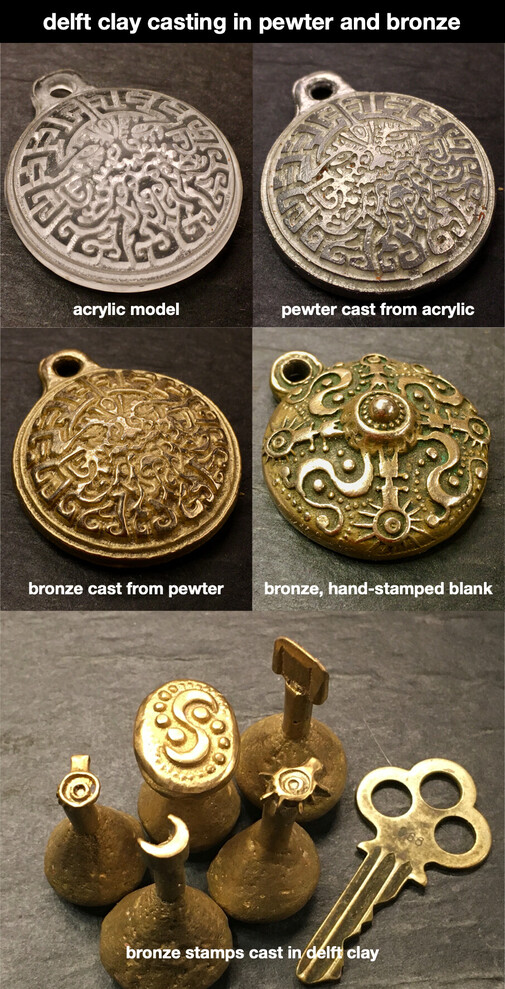
pewter/white metal is easy to melt, stays molten nicely for pouring, and captures great detail. it’s nice for jewelry, but too soft for stamping leather. but it could be nice for prototyping and sending out for professional casting. the delft clay captures nice sharp detail from the acrylic model (burned at 340 lpi), as reflected in the pewter model in the picture. the pewter model is straight from the clay mold with no finishing; i did polish the acrylic surface before burning the design with the GF. (it’s my understanding you can also pour white metal into silicone molds, though i haven’t tried it.)
the clay mold for the bronze was equally detailed, but the bronze model captures less detail. with only gravity to hold the bronze in the mold (as opposed to vacuum or centrifugal force you might use for investment casting), the metal contracts as it cools, pulling out of the mold a bit and resulting in some loss of detail. if you wanted sharper edges in the design for the leather stamps, you could grind down the surface to take off the rounded edges. i did this on the model in the lower right using a medium silicone abrasive wheel. this piece was made by pressing objects like keys and buttons directly into a delft clay mold made from a blank model. you could correct for the loss of depth from the grinding by burning your acrylic model a little deeper if necessary. in the darker, unpolished areas towards the middle of the fourth model, you can get a sense of the fine grain that a smooth surface produces in the clay.
i agree investment casting is an adventure! i enjoy it and it produces great results. another of its advantages is that it allows undercuts in your designs, which sand casting doesn’t – but i don’t think that would be an issue for your application. if you think it will give you the detail you want, you may find delft clay casting easier, cleaner, safer, faster for one-off pieces, and more economical than investment casting. the biggest technical challenges would be getting your ventilation in place and safely generating the heat needed to melt the bronze.
white metal does not char the clay due to the low temperature, so all the clay from the mold can be reused. bronze will char the clay, but the uncharred clay from the mold can be reused.
here are links to the materials i mentioned:
bronze casting grain (MSDS says 90% copper, 10% tin)
https://www.riogrande.com/product/ancient-bronze-casting-grain/706051
white casting metal
https://www.riogrande.com/product/aqua-clean-casting-metal/750150
delft clay casting kit
https://www.riogrande.com/product/delft-clay-casting-system/705136
silicone abrasive wheel
https://www.riogrande.com/product/EVE-Silicone-Black-Polishing-Wheel-Medium/332731
here is a good and approachable book on DIY casting:
Practical Casting: A Studio Reference, by Tim McCreight
cheers 
10 Likes
This is an amazing write-up- thanks so much!
you’re welcome, i look forward to seeing your work!